

SPECIFIC POLYMERS (SP - www.specificpolymers.fr) is an SME with 30 employees acting as an R&D service provider and scale-up producer in the field of functional building-blocks, polymers and materials with high specificity. Its main goal is to validate proofs of concept and develop tomorrow's materials, with green material chemistry, biomass valorization and circular economy at the core of its R&D.
Among thermosetting materials, epoxy polymers are used in construction, automotive, smart coatings or aerospace, due to their good adhesion, chemical resistance, and thermal and mechanical properties. Currently, 75% of epoxy polymers worldwide are prepared from the DiGlycidylEther of Bisphenol A (DGEBA). However, Bisphenol A is a reprotoxic substance whose use may be restricted in the future. SP's research is thus geared toward sustainable and/or biobased epoxy resins that could substitute DGEBA.
Within ECOXY, two kinds of products were developed and evaluated in parallel:
- Sustainable Aromatic Precursors — aromatic resins bearing multi-functional glycidyl ether moieties, based on vanillin alcohol or phloroglucinol (extractable from lignin and algae respectively). Two products are now sold for R&D: SP-9S-5-003 Phloroglucinol Triglycidyl Ether (PHTE) and SP-9S-5-005 Vanillin Alcohol DiGlycidyl Ether (DGEVA).
- Biobased epoxidized vegetable oils — a range with epoxy content from 2.5 to 7.0 meq/g, commercialised as SP-3S-30-005 (epoxidized castor oil) and SP-3S-30-006 (epoxidized vegetable oils from non-edible sources).
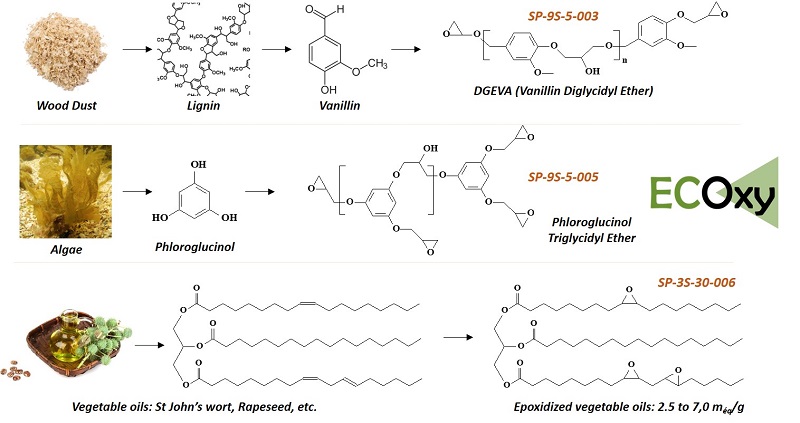
All epoxy resins were evaluated in epoxy-amine materials. Epoxidized vegetable oils reach a Tg between 15°C and 90°C, while DGEVA and PHTE formulations reach 90°C to 180°C. Thus it was possible to find a sustainable alternative to DGEBA. DGEVA and PHTE were retained as the most promising materials, with production scaled to 25 kg by the end of 2019 and 50 kg by the end of the project.
These products enable new sustainable thermoset materials with 3R properties, achieved by combining SP bio-based epoxy building-blocks with suitable dynamic hardeners. Compatibilization with flax or PLA fibres is being studied to prepare 3R composite materials.